Ditch the charger and wall outlets with the Epiphany onE Puck charger, a device that uses a drink's temperature (either hot or cold) to charge a smartphone or iPod.
News: HIV Testing Now Recommended for Teens
A paper released Monday by the American Academy of Pediatrics recommends that all 16-18-year-olds receive routine HIV tests if they live in an area with a human immunodeficiency virus (aka HIV, the virus that leads to AIDS) prevalence higher than 0.1 percent. Prior to the new guidelines, HIV testing was recommended only for teens who admitted to being sexually active.

While Dr. Jaime Martinez, one of the authors of the AAP paper, told CNN that though the number of new infections in sexually active teens has not decreased, researchers have found that youth who are aware of their HIV status practice safer sex and are less likely to pass on the disease [1]. An early HIV diagnosis could also delay the onset of AIDS— reason enough to suck it up and get tested!
The new recommendation also advocates for the rapid-response HIV test, which provides a diagnosis within 20 minutes, as opposed to other types of tests that can take more than a week to yield results. However, the AAP fears that pediatricians may not recognize the importance of HIV testing. Plus, they fear that at-risk adolescents may be uninsured or not have access to primary care physicians, making testing at emergency facilities a priority.
Wondering where the new guidelines will take effect? Areas with the highest incidence of HIV include Miami, New York, Washington, D.C., and (more generally) the southeast United States.
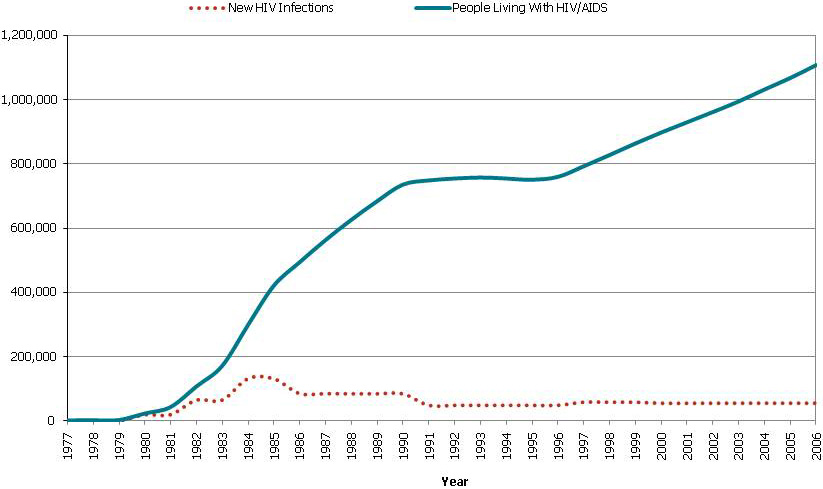
While the number of HIV infections plateaued in the ‘90s, some studies suggest that those numbers are on the rise again. Men who’ve had male partners are especially at-risk for infection, and surveys suggest young men are far more often unaware of their HIV status than their older peers.
Testing options include blood, saliva, and urine tests (the rapid, 20-minute test is a blood test). Many doctors provide HIV testing (check out specific places with this handy dandy locator), but testing is also available at many clinics and health departments, as well as with at-home testing kits. The CDC recommends everyone be tested for HIV at some point, and that people who participate in certain risky behaviors be tested annually.
Works Cited
- Interventions to modify sexual risk behaviors for preventing HIV infection in men who have sex with men. Johnson, W.D., Hedges, L.V., Diaz, R.M. Division of HIV/AIDS Prevention, Centers for Disease Control and Prevention, Atlanta, GA. Cochrane Database of Systematic Reviews, 2003;(1):CD001230.⤴


Comments Leave a comment
It is very Informative article.
"researchers have found that youth who are aware of their HIV status practice safer sex and are less likely to pass on the disease"
I'm quite certain researchers will also find that teens who have had the most exposure to a factual and comprehensive education, from a young age, about their own bodies, reproductive organs and sexual matters generally will be better informed about all matters pertaining to sex, including the issues around HIV/AIDS.
I definitely agree. Most research on the topic focuses on the effects of education after an HIV diagnosis. Which as far as I'm concerned is too little, too late. Hopefully the new testing policies will encourage an open, honest conversation between doctors and teenage patients.
Living with STDs can be really lonely. So it’s important for people with STDs to find a place to get support and find love. Fortunately, a friend of mine who are a single with STDs told me that the largest STDs dating site STDsMatch(dot)com now has more than 560,000 members, which makes it’s easier for singles with STDs to find support and love.
Definitely— social support is just as important as medical support IMHO.
I am also agree on this topic meaning. There are a lot of research on the topic focuses on the
effects of education after an HIV diagnosis.Our teenagers are now concerned About this,The new testing policies
will encourage to teach teenagers and friendly conversation between doctors and
teenagers and
patients.